
Measuring MEMS Anchor Loss With Complex Coordinate Stretching
How curvilinear Perfectly Matched Layers turn radiation into the substrate into a direct quality-factor readout, why anisotropic backward waves can destabilise an absorber, and how axisymmetric regularity tames r = 0.
Clamp the base of a finite MEMS wafer block rigidly and every mechanical mode looks artificially lossless: elastic waves travelling down the support stem simply bounce off the outer mesh wall and echo back into the resonator. Swap the clamp for a viscous dashpot (lrb) and waves hitting at oblique angles still reflect, while the frequency dependence turns the eigenproblem quadratic.
Surround the substrate instead with a curvilinear Perfectly Matched Layer (femcore::pml and nyx-sms::pml) and the system stays a linear generalised eigenproblem $K(\tilde{\mathbf{x}})\mathbf{u} = \omega^2 M(\tilde{\mathbf{x}})\mathbf{u}$. Outgoing waves decay smoothly inside the absorbing collar, leaving complex eigenfrequencies $f = f_{\mathrm{re}} + i f_{\mathrm{im}}$ that report anchor radiation damping directly as $Q = \mathrm{Re}(f) / (2|\mathrm{Im}(f)|)$.
Pulling Back Strains Without Complex Conjugation
Under nyx’s $e^{+i\omega t}$ time convention, outgoing waves decay whenever real spatial coordinates continue into the fourth complex quadrant along each active absorbing normal:
$$ s(t) = \kappa(t) - i \psi(t), \qquad \kappa(t) \ge 1, \quad \psi(t) \ge 0, \quad t \in [0, 1] $$
At each quadrature point, pml_jacobian evaluates the metric Jacobian $J_s = \partial \tilde{\mathbf{x}} / \partial \mathbf{x}$, its analytical inverse, and $\det J_s$. One mathematical detail makes or breaks convergence: variational assembly must use the non-conjugated complex-symmetric bilinear form, pulling strains back via $J_s^{-T}$ and scaling element volumes by $\det J_s$ rather than conjugating shape derivatives.1.A quadratic grading ramp (order = 2.0) keeps $s(0) = 1$ at the substrate interface so mesh transitions stay reflectionless, while real stretching $\kappa > 1$ damps evanescent near-field tails faster inside compact boxes.
Watching Substrate Modes Separate From Beam Modes
In examples/11_anchor_loss.nyx.json, a 20 mm × 300 mm steel beam rests atop a 600 mm × 350 mm substrate flanked on three sides by 5-layer Cartesian PML wings. Solving 4,832 P2 DOFs takes 0.086 seconds and cleanly separates sharp beam bending modes from continuous damped waves inside the substrate:
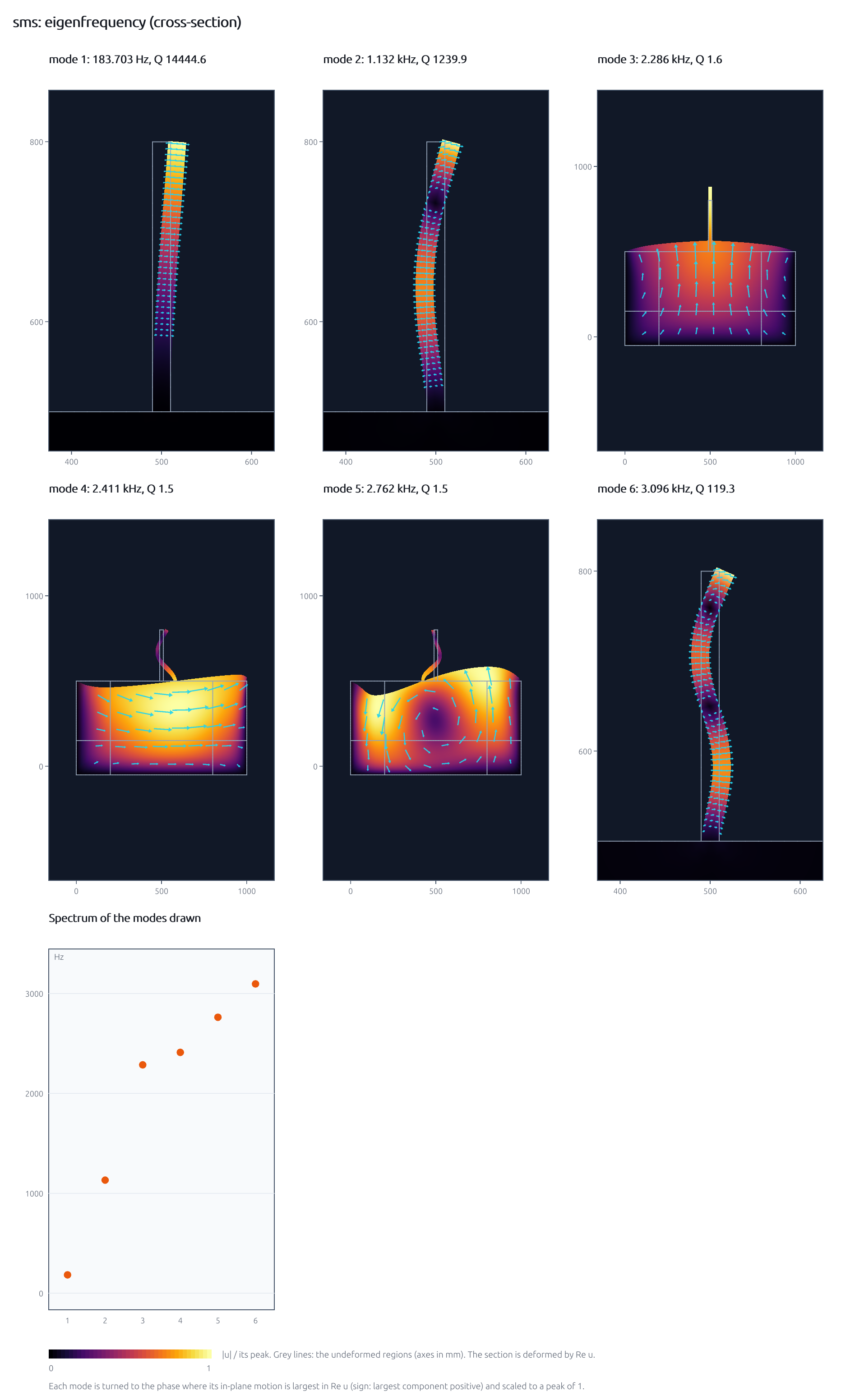
$ nyx run render_site_figures.nys # 11_anchor_loss
sms: eigenfrequency, order=2, dim=2, dofs=4832, seconds=0.0858
  solver_kind: shift_invert_complex, converged: true, restarts: 9
  max_algebraic_residual: 6.254677404565312e-12
  mode 1: 183.703 Hz + 6.359e-3i Hz   (Q = 14444.57, layer_frac = 2.714e-07, P_pml = 553.37 W)
  mode 2: 1132.207 Hz + 0.4566i Hz    (Q =  1239.95, layer_frac = 9.086e-05, P_pml = 251.08 kW)
  mode 3: 2286.157 Hz + 710.22i Hz    (Q =     1.61, layer_frac = 2.715e-01, P_pml = 36.66 GW)
  mode 4: 2410.962 Hz + 827.02i Hz    (Q =     1.46, layer_frac = 3.537e-01, P_pml = 105.59 GW)
  mode 5: 2762.168 Hz + 925.32i Hz    (Q =     1.49, layer_frac = 5.202e-01, P_pml = 87.59 GW)
  mode 6: 3096.439 Hz + 12.979i Hz    (Q =   119.28, layer_frac = 5.753e-03, P_pml = 20.48 MW)
  unstable_modes = 0
Notice how layer_frac—the fraction of elastic energy sitting inside the PML collar—acts as an automatic physical classifier: true cantilever modes keep 99.4% to 99.9999% of their motion in the beam and substrate core, whereas spurious box modes (3, 4, 5) dump 27% to 52% of their energy straight into the absorber with $Q < 2$.
Taming Anisotropic Backward Waves & $r = 0$ Regularity
Single-crystal substrates add a nasty physical trap: along concave regions of the Christoffel slowness surface, a wave’s group velocity and phase velocity can point in opposite directions ($\mathbf{v}_p \cdot \mathbf{v}_g < 0$). Feed one of those backward-wave cones into a standard complex stretch and the PML flips from an absorber into an amplifier (Im f < 0), seeding unstable growing modes. Before assembling element matrices, nyx-sms::pml inspects the wafer-rotated stiffness tensor via backward_wave_mpml_ratio, applying multi-axial real stretching stabilisation automatically whenever backward cones cross an absorbing boundary.
For circular disk resonators modelled in cylindrical coordinates (sms::axisymmetric_eigenfrequency), azimuthal displacement varies as $e^{-i m \theta}$ and the $1/r$ hoop-strain terms require exact regularity right on the symmetry axis $r = 0$:
- Torsional and radial-axial breathing modes ($m = 0$) clamp radial and twist motion ($u_r = u_\theta = 0$).
- Flexural tilt modes ($|m| = 1$) clamp axial lift ($u_z = 0$).
- Higher whispering-gallery harmonics ($|m| \ge 2$) vanish completely on axis ($u_r = u_z = u_\theta = 0$).
Validated against Bindel and Govindjee’s 2005 polysilicon disk-on-post benchmark (R = 6 µm, 450.155 MHz), cylindrical PML wings remain invariant across absorber thickness and damping strength without spuriously pinning the axis.