
Avoiding Spurious Waveguide Modes in Mixed Nédélec Elements
Why nodal waveguide solvers invent fake modes across high-index silicon boundaries, how a mixed Nédélec(2)+P2 formulation in the wafer frame eliminates them structurally, and what happens inside an open cylindrical PML.
Anyone who has tried solving a high-index optical waveguide with ordinary scalar nodal elements recognizes the headache: mixed into the real guided modes are unphysical “spurious” eigenvalues whose fields oscillate wildly near sharp corners.
The geometry of Maxwell’s equations explains why. At the boundary of a silicon wire ($n_{\mathrm{Si}} \approx 3.48$) clad in oxide ($n_{\mathrm{SiO}_2} \approx 1.44$), tangential electric fields remain continuous while the normal component $E_\perp$ must jump by a factor of $\varepsilon_1 / \varepsilon_2 \approx 5.8$. Nodal Lagrange elements force every vector component to be continuous across element edges—so either the solver smooths over a physical jump or it hallucinates gradient modes $\mathbf{E} = \nabla \psi$ that fail $\nabla \cdot (\varepsilon \mathbf{E}) = 0$.
Inside nyx-ems::modes, we banish spurious modes from the function space itself rather than trying to filter them out afterwards.
Mixed Curl-Curl Eigenmodes in the Wafer Frame
Every cross-section model lives in the wafer frame: x lies laterally across the chip, z points normal to the wafer surface, and guided waves propagate along +y as $\mathbf{E}(x, y, z) = (\mathbf{E}_t(x, z) + \hat{\mathbf{y}} E_y(x, z)) e^{-j\beta y}$.1.Crystal permittivity and permeability tensors are rotated once inside femcore::section::local_tensor so solvers operate in consistent local axes while fields export under wafer names (Ex, Ez transverse; Ey along propagation). Rescaling the longitudinal component to $\phi = E_y / (j\beta)$ splits the transverse vector field into degree-2 Nédélec edge elements ($e_t$, 8 DOFs per triangle: 3 Whitney edge functions, 3 edge-bubble gradients, and 2 interior functions) paired with quadratic P2 Lagrange elements for $\phi$:
$$ \begin{bmatrix} S - k_0^2 T_e & 0 \\ 0 & 0 \end{bmatrix} \begin{bmatrix} e_t \\ \phi \end{bmatrix} = -\beta^2 \begin{bmatrix} T_m & G \\ G^T & K_p - k_0^2 T_p \end{bmatrix} \begin{bmatrix} e_t \\ \phi \end{bmatrix} $$
Here $S$ is the curl-curl stiffness matrix, $T_e$ and $T_m$ are edge mass blocks weighted by $\varepsilon_r$ and $\mu_r^{-1}$, and $G$ couples edge fields to $\nabla_t \lambda$. Every discrete gradient field sits strictly at $\beta^2 = 0$ by de Rham exactness, leaving the shift-and-invert Krylov solver free to lock cleanly onto physical modes near a target index.
Testing on a Silicon-on-Insulator Wire
To see the formulation in action, take the standard 500 × 300 nm silicon strip waveguide (15_soi_wire) at 1550 nm with 986 triangles across the core and oxide cladding:
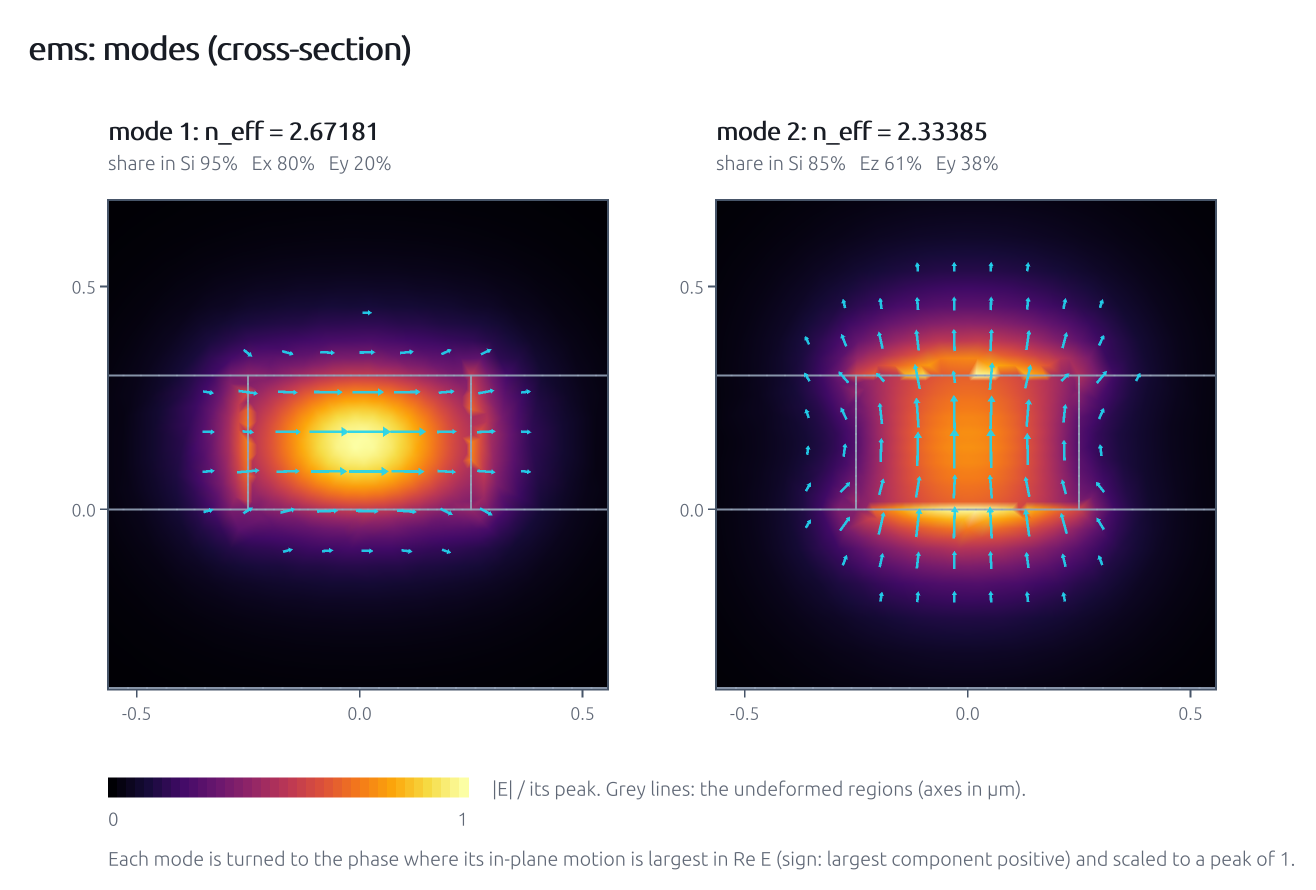
Compared against archived Lumerical and MPB reference indices (2.67179 for TE0 and 2.33374 for TM0), even this lightweight mesh lands within 7.9 ppm on TE0 and 47 ppm on TM0 in 80 milliseconds:
$ nyx --batch examples/15_soi_wire.nyx.json
986 cells, 515 points
ems: solved in 0.08 s, 2015 dofs, 2 solution(s)
  neff 1 = 2.671811
  v_g 1 (m/s) = 71431926.58486077
  n_g 1 = 4.19689727455199
  Ex share 1 = 0.8002390961141337
  Ey share 1 = 0.19720412785316194
  Ez share 1 = 0.0025567760327043277
  share in Si 1 = 0.9451175893630006
  neff 2 = 2.333849
  v_g 2 (m/s) = 64758283.71708667
  n_g 2 = 4.629407093457278
  Ex share 2 = 0.011127642624896001
  Ey share 2 = 0.38206400952785785
  Ez share 2 = 0.606808347847246
  share in Si 2 = 0.8510136106501677
  field frame = lateral x, normal z, propagation y, left-handed
what the solver did:
  solving EM waves (mode analysis) on a 2D mesh of 986 cells: 0.08 s
    factorising a sparse general matrix (6819 unknowns, 150676 non-zeros); this cannot be interrupted: 0.04 s
One honest detail the solver reports on this coarse 986-cell mesh: because the search shift sits at n_target = 2.75, close to TE0 (2.672), mode 1 converges cleanly (1.33e-4 residual) while mode 2 (TM0, 2.334) finishes with a slightly higher 2.10e-3 algebraic residual after 14 Arnoldi restarts. Aiming n_target closer to 2.35 or refining the cladding mesh drops both residuals below 1e-12.
Polarisation Invariants That Ignore Solver Phase
Eigensolvers return fields scaled by an arbitrary complex phase $e^{i\theta}$, which means inspecting raw Ex and Ez components at one grid point can flip sign or swap real and imaginary parts across runs. nyx-analysis::polarization solves this by integrating bilinear Stokes parameters across the waveguide cross-section:
$$ S_0 = |E_{\mathrm{lat}}|^2 + |E_{\mathrm{nor}}|^2, \qquad S_1 = |E_{\mathrm{lat}}|^2 - |E_{\mathrm{nor}}|^2, \qquad S_2 = 2,\mathrm{Re}(E_{\mathrm{lat}}^* E_{\mathrm{nor}}), \qquad S_3 = -2,\mathrm{Im}(E_{\mathrm{lat}}^* E_{\mathrm{nor}}) $$
Since every Stokes component pairs a conjugate field with an unconjugated field, arbitrary phase factors cancel out identically, making orientation angle, ellipticity, and Poincaré-sphere distance completely reproducible.
Cylindrical PML Annuli Without Splitting Quads
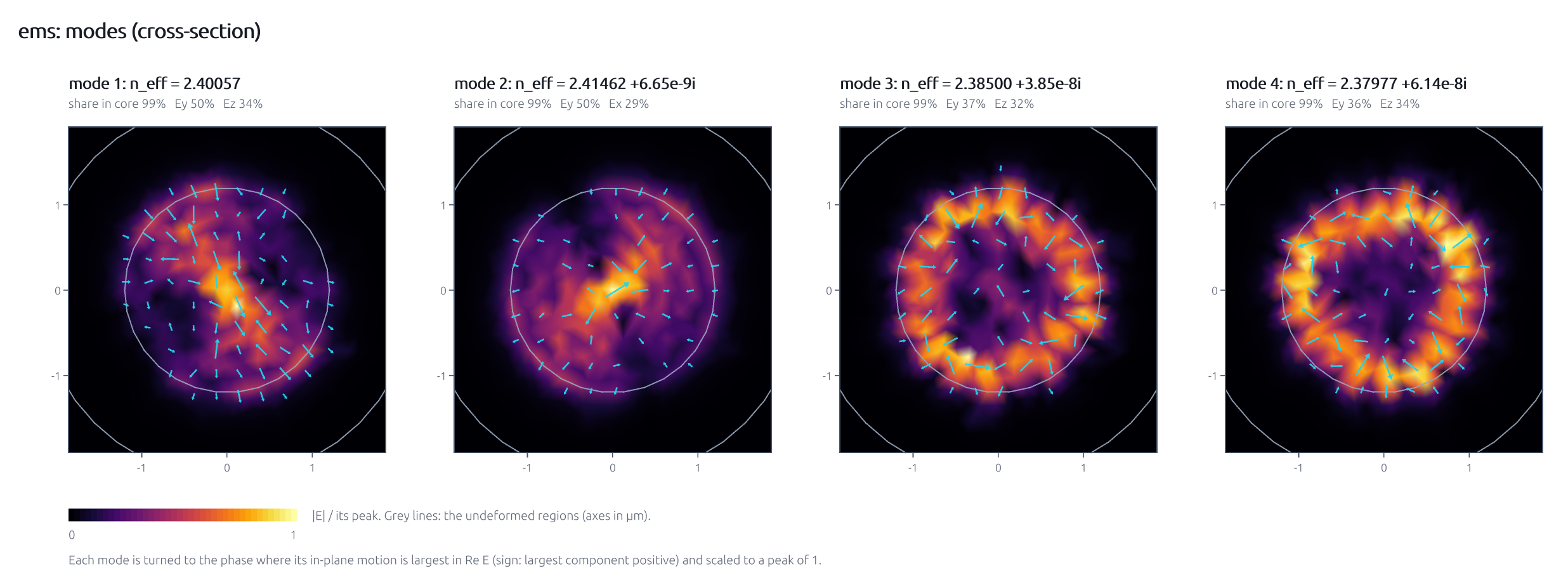
Open structures such as whispering-gallery cylinders radiate small amounts of light outwards even in well-confined modes. Instead of truncating air with a hard metal box or splitting structured ring grids into skewed triangles, nyx-ems extrudes native quadrilateral cylindrical PML shells orthogonal to the outer boundary (18_wgm_cylindrical_pml), solving 5,225 DOFs to 8.7e-14 residual in 0.38 s:
$ nyx run render_site_figures.nys # 18_wgm_cylindrical_pml
ems: modes, order=2, dim=2, dofs=5225, seconds=0.3793
  solver_kind: shift_invert_complex, converged: true, restarts: 64
  max_algebraic_residual: 8.716388532767634e-14
  mode 1: neff = 2.400572 -1.559e-10i   (n_g = 4.9502, core = 0.9900, res = 1.375e-15)
  mode 2: neff = 2.414624 +6.653e-09i   (n_g = 4.9195, core = 0.9899, res = 4.588e-14)
  mode 3: neff = 2.385004 +3.849e-08i   (n_g = 5.0502, core = 0.9932, res = 6.400e-14)
  mode 4: neff = 2.379766 +6.144e-08i   (n_g = 5.0591, core = 0.9932, res = 8.716e-14)
Less than 4.2e-10 of each mode’s energy sits inside the PML ring itself—confirming the modes live genuinely inside the dielectric cylinder rather than being artificial absorber reflections.